20 Mar 2026
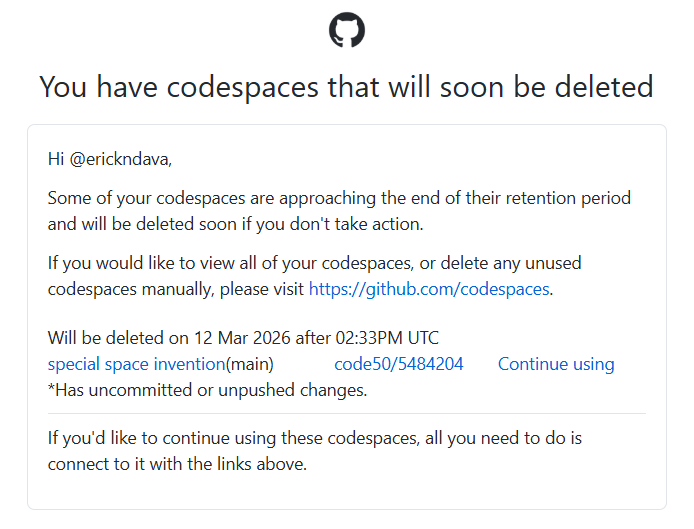 |
| A Courtesy email from GitHub |
CS50 is in the rear view mirror now. It’s been almost one and half months since I started my formal studies and the lessons I picked from Dr Malan’s class have come in handy. This post is a reflection on how CS50 set me up to do well as I started to study. I will focus on four things.
1. A Development Environment
It was a no brainer to find a codespace simliar to the CS50’s development enironment to use for my task assignments. I quickly grabbed a ready-to-go Codespace, with R as a language of choice. Running the codespace from a GitHub repository was intuitive. This gave an environment that I was familiar with and I could focus on the task at hand and not environment tweaking and installation headaches. I did not even consider having a local dev environment.
Use of Visual Studio and the Terminal were familiar territory. The Codespace I chose has the R IDE, R Studio but, I found myself using that less, preffering rather to stay at the terminal. CS50 taught me enough commands and directory navigation to be productive.
2. The Power of Pseudocode
Breaking the assignment task into parts and using that as pseudocode is a useful skill I picked up in CS50. This programmatic thinking helps simplify the problem into digestible chunks and functions are easy to develop and the bigger picture easy to conceive. A block at a time, I can come up with the solution, without being overwhelmed by the entire elephant. This pseudo coding also enhance code documentation. It is easy to track what I need to do.
3. Learning A ‘New’ Language
In CS50 I touched C, Python, some JS, Flask and HTML. For my studies
however I settled on R, a language I had spend sometime with. CS50’s philosophy was to instruct enough such that one can teach themselves any other programming language. The fundamentals remain the same, just that the syntax has changed.
Introduction to Computer Science, gave an environment with some training wheels. With my new setup, I have the liberty to extend functionality by including code-autocompete, utilise Copilot to explain code and assist in refining implementations. The goal now is not to learn programming but to impement good algorithms and solve problems.
This is not all I have benefited, I got enough grounding to take off this journey and now I focus on thinking as a Data Scientist and mastering the necessary tools. I’m spending some time with code:
 |
| Some Time With Code |
14 Jan 2026
From Week 8, work and other pressing issues broke my week-on-week streak! Necessary learnings where gotten nonetheless. With a planned more intense study schedule, I will make use of “work-family-study-time balance” lessons learnt when the studies assume.
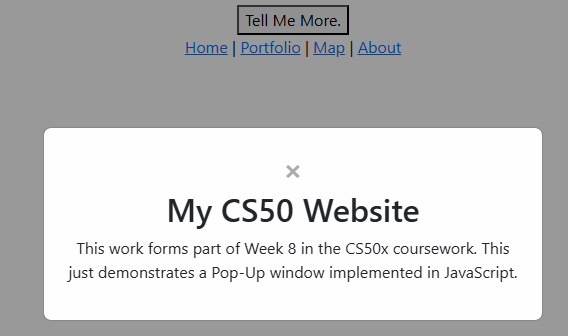 |
| A Modal Pop-up - JS/ CSS |
Content in Week 8 was not too foreign. Being the network administrator of my fibre to the home network, lessons on TCP/IP was familiar ground. I knew enough of how traffic traverses the web - my home network is customised with a PiHole and has network wide DNS filtering.
Having setup my blogging site in 2015 from scratch and through several iterations, writing HTML code felt at home. I have in my portfolio, some web-mapping projects which leverage HTML. The twist came when it was time to delve deeper in Java Script. Earlier learning through the course drove home the fact that the course is really about learning to learn new languages more quickly and easily.
In the years past I have fiddled with the LAMP Stack. Experiencing Flask in Week 9 was a breath of fresh air. Quickly seeing the results of one’s development efforts. Early on, it was not easy untangling the interlinked parts (documents) of a Flask app. But once understood, it makes sense as the power of templating and frameworks is exposed. It becomes rather
convenient.
 |
| A Flask App. Running |
Meeting The Objective
One of the objectives of this blog series was to:
- Have a fresh and solid base for when starting the PGDip studies
As the deadline for application for the PG Diploma drew close. I pushed to get across the completion line of CS50. There just wasn’t enough time to finish Week 10, The Project. I successfully completed Week 0 - 9 with the required assignment passmarks.
I used the tasks transcript to ‘motivate’ for my ‘Computer Science Course equivalent to a University First year course. It turned out I didn’t need to take this course! 20 years ago I did Computer Science for Engineers for my BSc Studies and that was sufficient. Nothing though replaces the 6 months of refreshing my knowledge, un-learning, re-learning and cementing current knowings though, before 31 October 2025.
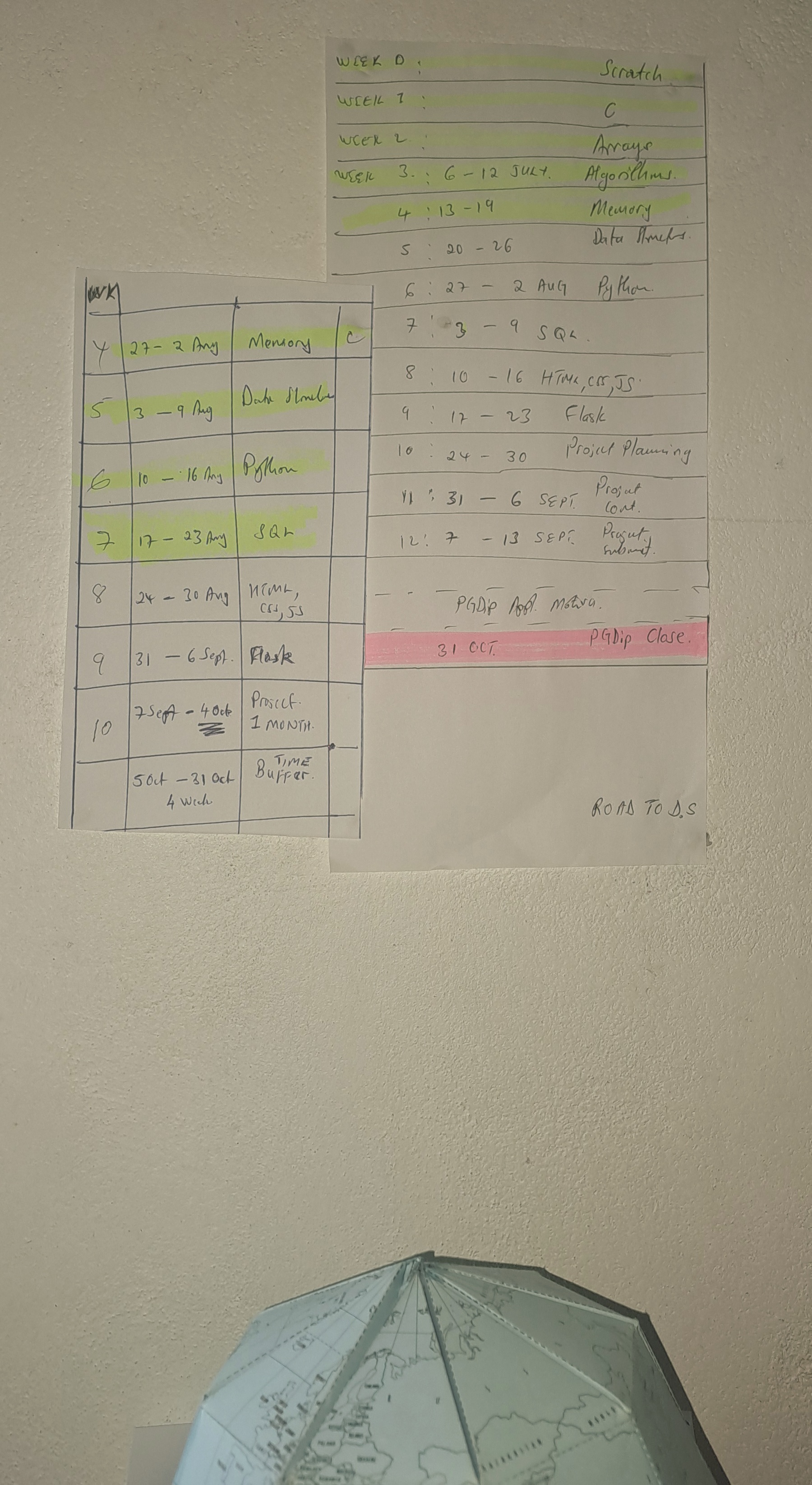
With time, I must still do the Final Project to get the Harvard Certificate. ..before then, let me drop the morphed on-wall study schedule.
 |
| Personal CS50 Schedule |
05 Sep 2025
As opportunity would have it, this week I was on a work sponsored esri training course, ArcPro Advanced. One of the topics covered was Simple SQL Queries. CS50’s SQL Topic became an opportunity to re-learn SQL, dive deeper and master the proper crafting of queries.
The first part turned out to be a great easy-going refresher. As a spatial scientist I ask spatial data questions all the time. As geohipsters, we actually have a cute file format, geopackage which is essentially a sqlite database. In the course of the material. I couldn’t help reminisce PostGIS and SpatialSQL. I have a decent exposure to SQL but, further on with Week 7 content, queries became complex and my learning began to compound.
I noticed a personal preferance when it came to constructing queries, favouring
JOIN ... ON ... ---Inner Joins
versus
SELECT ... FROM ( SELECT ... ---Subqueries/ nested SELECT statements
Which was an interesting introversion of how I understood things. At the end of it, it was great mastering the alternative.
The brief discussion of SQL Injection attacks during lectue was very intriguing. A peek into cybersecurity.
Learnings for the geo-person
-
Geospatial software leverage relational databases ubiquitously. As such, the topic of databases is one that cannot be side stepped in the profession. It is one that can actually be divergent, as some projects demand tools which emphasise data storage versus a spatial view. Few years back I was intrigued by a command line spatial data viewer which connected to PostGRES with a PostGIS extension. Not long DBeaver, a universal databae tool, debuted with a spatial viewer.
Something that was domain specific to GIS.
-
A great geospatial scientist should know above average SQL. Increasingly, it is apparent that spatial is just another column in the database. But the gis tech, has the advantage of spatial thinking.
-
After completing this section, I can now do nested and more complex queries. Behind every icon in the spatial manipulation software GUI. The ready to use Intersect icon, is actually a
     SELECT spatial_features FROM spatial_table_A
         JOIN spatial_table_B
         ON spatially_congruent_features
-
My greatest gain from this section was learning to work with database informaton programmatically. This came through the Fiftyville task of Problem Set 7.
-
In all honesty, I underestimated the depth of topic for this section. It was a great break from general purpose programming and I learnt much much more on SQL. I now appreciate better, the responsibilities of a DBA. The prospects of the average geospatial scientist expanding into webmapping and scripting become greater.
That’s Week 7, now looking forward to HTML, CSS and JavaScript. Again topics not too foreign but another opportunity to re-learn stuff. As a parting note…Little bobby tables :laughing: .
`Robert'); DROP TABLE Students;--`?
19 Aug 2025
As a spatial scientist, starting on Python was particularly interesting. The language is largely preferred for spatial data manipulation operations. At this point, I hadn’t delved Python to any great depth except encountering it in scripts at my 9 - 5 job, in esri software.
In this week’s Lecture, Shot and Section, Python is really dealt like rock skipping, touching the surface but, never sinking to depth. It was really about “How to Teach Yourself a New Programming Language”. Even with the Problem Set, the same was reiterated.
If I should gripe a little, every time the codespace had to be updated, I lost my theme - Cobalt 2. It however was not a pain getting things back to the way they were.
 |
| Codespace My Way - A Dark Mode |
Learning a New Programming Language
It was not a struggle following highlights of differences between C and Python. What I had to contend with was ‘throwing away’ all the attention to detail and ‘pseudo-control’ over what the code was doing. Python is high level and I had to actively ignore the under the hood stuff I knew coming from C and ‘trust’ the computer to do the right thing. The compactness of Python code was a breath of fresh air!
Because with Python indentation matters, it sort of forced one to create clean code from the start. The CS50 coding environment screamed Problem, when a (tab) was missing.
After this brief run with Python, I found myself also asking the popular question Python or R. Because of the time I have invested in R for Data Science, I have developed some fondness for R. Curious about what the future holds.
Revisiting Code
I grappled briefly converting my for loops from C to Python (sentimental-mario-less). But because I understood my code, with a little experimentation, I eventually got the code to work.
In one of the problems, I found myself using Debug50 to trace variable changes. The problem brief from C had been twisted from dealing with integers to now dealing with floating point numbers in Python. It was exciting experiencing first hand float point precision! The computer was working with 0.009999999999999967 whereas my expectation was 0.01. As a consequence, my function returned 0.0. With some research I employed round(change,2) which solved the problem. A successful debug, always scratches the inquirer’s itch.
I also found a bug in my older code which I had inadvertently gotten away with. It was with a word counting function. Occurrence of ‘.’ or space indicated end of a word but hadn’t factored where they occurred together viz. (dot)(space). I therefore ended up with an inflated word count.
Coding fatigue is a real thing. Even after six weeks of coding, tiny errors are still possible and fundamentals of debugging still have to be observed. This was after my program just hung on execution because I had missed code to increment a counter.
Reflections
Again I learn that every problem at first glance looks insurmountable. The problem set on DNA, felt overwhelmed on first encounter. But by applying modular programming, sub-tasking and pseudo-coding, I was soon on my way disintegrating it piece by piece.
I am looking forward to SQL and having to take a break from general purpose programming languages. The week-to-week tempo I adopted in the face of limited time makes everything feel like a rat race, albeit exciting, in the face of a weekend deadline.
Let me put an end of post bar hereunder in the form of a progress bar, which surprisingly is blue from red at the moment.
 |
| The Gradebook - Blue Zone Progress |
07 Aug 2025
 |
| The Gradebook - Looking at Progress |
So after submission of Week 5 Problem Set solutions, the above is my current progress. Now just a little over the halfway mark of the course. I foresee of course that the Final Project (FP) will take longer than a week. The week’s lecture material was quite comprehensible, relaxing almost. Dr Malan has a way of explaining complicated concepts from basic building blocks, from the ground up. The video clip aids, such as the t-shirts from a box and those from hangers, really drove home the concepts of Stacks, FIFO and LIFO.
The previous week on memory, was a bit intense as the code became more complex. Had the motivation for studying not been strong, Week 4 was a good time to quit. But, as I have learned from Learning Hard Topics, some topics are challenging like that. With the content of Week 5, It’s clear now that was necessary foundation. The week is a culmination of C and will veer off to Python in Week 6 (looking forward to that). It feels truly like a peak of the course and I am expecting to now plateau.
From so much use of loops and defaulting to ‘i’ as a loop variable I concluded that the i stands for any of - integer, iterate, initialise, index.
 |
| The ‘i’ |
Being Practical with C
Going over the Inheritance (Problem Set 5), one really appreciates how everything learnt up to this point - assignment (now of pointers), arrays, memory, loops, conditionals, truth checking and more, ties together. The utility of the C Programming language is demonstrated through implementation of a practical biology ‘problem’ - determining permutations of Blood Type.
I couldn’t help pondering though, the experience by someone encountering this computer science material for the ‘first time’, in my limited time circumstance would fare. A week-by-week tempo, is manageable for someone who can spare a few hours a day delving the content and not necessarily a full-time worker without a burn of midnight oil.
What I learnt About Complex Problems
Problem Set 5, Part 2, Speller was the most challenging, yet, of the course. It has so many ‘moving parts’ i.e. functions and also incorporated a lot, if not all, of the concepts learnt so far. I perceive the objectives I set out at the beginning of the course are gradually being met. Some take-aways:
-
I learnt (again) and got reinforcement that breaking a problem into sub-problems should be a default approach when tackling a complex task. For each of the 5 functions to be completed, I could independent apply the most appropriate logic to each.
-
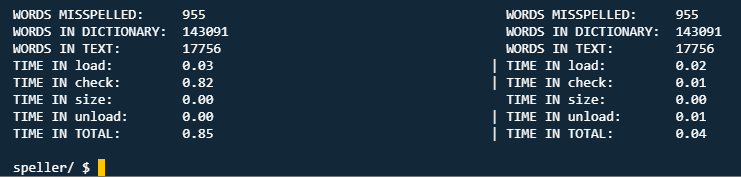
Benchmarking is a fascinating way of improving one’s code and algorithms. I found the exercise of improving the efficiency of my already functional code exciting. The Ideas of good program design, I was experiencing in practice.
-
The many functions and and code files other people had written which I had to work with, made me understand better the concept of code collaboration.
-
Walking away from a challenge and coming back later seem to be working for me versus banging my head on the keyboard until I get it. There are instances though where once you get a ‘scent’ to cracking the problem, you can’t detach until you get it done, then only walking away with the delight of success.
 |
| Benchmarking - How good is your implementation? |

